

GDS vs Multi-Source Travel Platforms: Which Model Delivers Better Profitability?
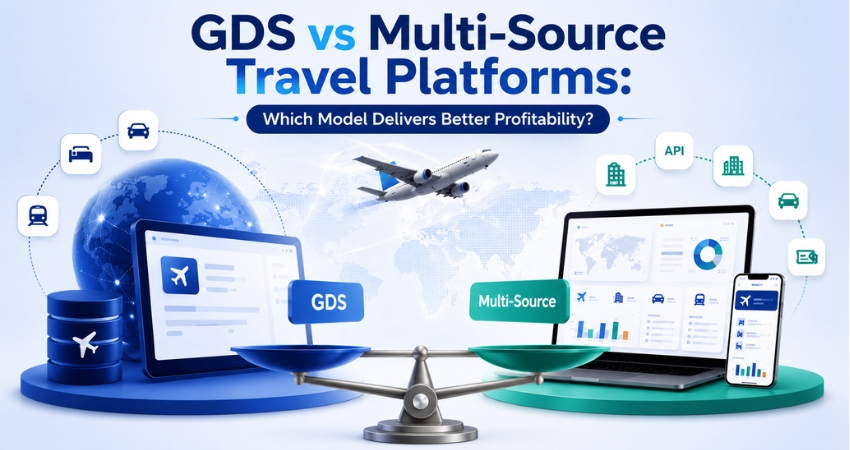
Every travel business eventually faces the same strategic question: Should you build your booking engine around a GDS, or invest in a multi-source travel platform that connects multiple suppliers at once?
This decision goes far beyond technology. Your distribution model directly impacts your commission structure, inventory access, operational costs, scalability, and overall profitability.
In this guide, we compare GDS vs multi-source travel platforms by looking at cost, flexibility, margins, and long-term growth potential. This will help travel agencies, OTAs, and tour operators choose the right model for their business in 2026.
What Is a GDS in Travel Distribution?
A Global Distribution System (GDS) is one of the oldest and most established travel distribution networks. Platforms such as Amadeus, Sabre, and Travelport connect travel businesses with airline, hotel, and car rental inventory through a centralized system.
For decades, airlines and large hotel brands have depended on GDS networks because they provide reliable access to corporate travelers and traditional travel agencies worldwide.
The biggest advantage of a GDS is its content quality. Businesses get access to:
- Real-time airline seat availability
- Accurate fare rules
- Complex itinerary support
- Corporate travel compatibility
However, this reliability comes with higher costs. GDS access often includes booking fees, segment charges, certification requirements, and long-term agreements that may not suit smaller travel businesses.
What Are Multi-Source Travel Platforms?
A multi-source travel platform follows a more flexible approach. Instead of depending on a single distribution network, it combines inventory from multiple suppliers through XML/API integrations.
These platforms can connect with:
- Hotel API providers
- Flight API providers
- Tour and activity suppliers
- Direct hotel contracts
- Regional travel consolidators
Solutions like TravellGDS allow travel businesses to combine GDS content with non-GDS suppliers, creating a unified travel portal with broader inventory options.
The biggest benefit is flexibility. Businesses can compare multiple suppliers, find better pricing, and select providers that offer stronger profit margins for specific destinations or products.
Profitability Analysis: Comparing Cost Structures
The GDS Cost Model
A GDS typically operates on a transaction-based pricing model. Travel businesses may pay booking fees, segment fees, and additional charges depending on their agreement and booking volume.
For agencies with high booking volumes, these costs can be justified because GDS provides reliability and access to global inventory. However, smaller agencies may find that these fixed costs reduce their profit margins.
Another factor is the cost of GDS integration, including technical setup, certification, staff training, and ongoing maintenance.
Despite these costs, GDS platforms can protect profitability by reducing booking errors, improving fare accuracy, and minimizing customer disputes.
The Multi-Source Platform Cost Model
A multi-source travel platform changes the traditional cost structure by replacing dependency on a single distribution channel with multiple supplier connections.
Instead of paying fixed distribution costs, businesses can work with different suppliers and choose the options that provide the best combination of price, availability, and commission.
By connecting with multiple sources such as a hotel API provider, flight API provider, tour suppliers, and direct contracts, travel companies can:
- Compare multiple rates before confirming a booking
- Select suppliers with better profit margins
- Reduce dependency on a single inventory source
- Expand product offerings faster
The primary investment is developing or adopting a reliable travel portal development solution that can handle multiple API connections, inventory synchronization, and booking workflows.
Working with an experienced travel technology partner is important because a poorly designed integration system can create performance issues, booking failures, and maintenance challenges that reduce profitability.
Which Model Delivers Better Revenue and Margins?
The answer depends on the type of travel business and customer segment you serve.
For companies focused on corporate travel and high-volume airline bookings, a GDS remains highly valuable. It provides accurate fares, reliable ticketing, and strong compatibility with corporate booking requirements.
However, for OTAs, leisure agencies, and businesses focused on hotels, holiday packages, and activities, multi-source travel platforms often create better profit opportunities.
The reason is simple: businesses can compare supplier rates, select better-margin options, and avoid relying on a single pricing structure.
Many successful travel companies now follow a hybrid approach:
- Use GDS for airline content and corporate travel requirements
- Use API integrations for hotels, tours, and activities
- Combine multiple suppliers inside one booking platform
This approach provides the reliability of GDS with the flexibility and profitability advantages of a multi-source ecosystem.
Scalability and Flexibility Considerations
A traditional GDS setup can become restrictive when a travel business wants to expand into new products or markets.
Adding a new supplier often requires separate technical connections, additional contracts, and manual management processes.
A well-designed multi-source travel platform is built for expansion. Businesses can easily connect new suppliers, add travel categories, and enter new markets without rebuilding their entire booking infrastructure.
This flexibility is especially useful for companies planning to add:
- New hotel inventory sources
- Regional travel suppliers
- Activity and experience bookings
- White-label travel solutions
- Specialized travel services
For growing travel businesses, scalability is not just a technical advantage; it directly impacts revenue growth and operational efficiency.
Real-World Use Cases: Choosing the Right Model
Different travel businesses have different distribution requirements. The right model depends on your customers, booking volume, and growth strategy.
-
Corporate Travel Management Companies:
A GDS-first approach works best because these businesses require accurate airline content, corporate fares, and reliable ticketing processes. -
Leisure-Focused OTAs:
Multi-source platforms provide better opportunities through competitive hotel rates, package options, and supplier flexibility. -
Regional Travel Agencies Expanding Internationally:
A hybrid model allows agencies to combine GDS reliability with local supplier connections. -
Travel Startups Building New Booking Engines:
Multi-source platforms offer faster deployment, lower entry barriers, and the ability to scale based on market demand.
How TravellGDS Helps Build the Right Distribution Strategy
TravellGDS helps travel agencies and OTAs create flexible booking ecosystems that are not restricted to a single supplier network.
By combining hotel API provider and flight API provider integrations with GDS connectivity when required, TravellGDS develops travel portal development solutions designed around business goals.
The focus is not simply adding more suppliers. It is creating a smarter distribution system that helps businesses improve:
- Inventory coverage
- Booking efficiency
- Supplier flexibility
- Revenue opportunities
- Long-term profitability
Ready to Improve Your Travel Distribution Profitability?
Choosing between a GDS and a multi-source travel platform is not about following the latest technology trend. It is about selecting a distribution model that matches your business goals, customer needs, and revenue strategy.
A GDS remains a powerful solution for businesses that require reliable airline connectivity, corporate travel support, and global booking capabilities.
A multi-source platform provides greater flexibility for businesses looking to expand inventory, improve pricing competitiveness, and increase profit margins through multiple supplier connections.
For many modern travel businesses, the best solution is a hybrid approach that combines GDS reliability with multi-source flexibility.
If you are planning a new travel portal development project or improving your existing booking system, TravellGDS can help you design a distribution strategy focused on long-term growth and profitability.
Talk to a TravellGDS travel technology specialist today and discover the right distribution model for your travel business.
Frequently Asked Questions
What is the main difference between GDS and a multi-source travel platform?
A GDS connects travel businesses to a centralized network of airline and hotel inventory, while a multi-source travel platform combines multiple suppliers and APIs into one system. This gives businesses more inventory choices and pricing flexibility.
Is a multi-source travel platform more profitable than GDS?
It depends on the business model. For leisure travel companies, OTAs, and hotel-focused businesses, multi-source platforms often provide better margins because they allow real-time supplier comparison. For corporate airline travel, GDS can still provide strong value through accuracy and reliability.
Can I use both GDS and a multi-source travel platform together?
Yes. Many travel companies use a hybrid model. They use GDS for airline bookings and corporate travel requirements while integrating multiple APIs for hotels, tours, activities, and other travel products.
How long does it take to set up a multi-source travel platform?
The timeline depends on the number of suppliers, required features, and system complexity. API-based integrations are generally faster to implement compared with traditional GDS certification processes.
Does switching from GDS to a multi-source model require rebuilding my entire booking system?
Not always. A properly designed integration layer can add new supplier connections alongside your existing GDS setup. This allows businesses to expand their inventory without completely replacing their current technology infrastructure.
Which travel businesses benefit most from a multi-source platform?
OTAs, tour operators, travel startups, and leisure-focused agencies usually gain the most benefits because they depend on competitive pricing, wider inventory options, and flexible supplier relationships.
Final Thoughts
The future of travel distribution is moving toward flexibility, automation, and multiple inventory sources. While GDS continues to play an important role in global travel connectivity, multi-source travel platforms are helping businesses create more competitive and profitable booking experiences.
The right choice depends on your business model. Whether you need GDS connectivity, API integrations, or a complete hybrid solution, the goal should always be the same: building a travel ecosystem that improves efficiency, customer experience, and profitability.