

AI-Powered Travel Portal Development: The Complete Guide for 2026–2027
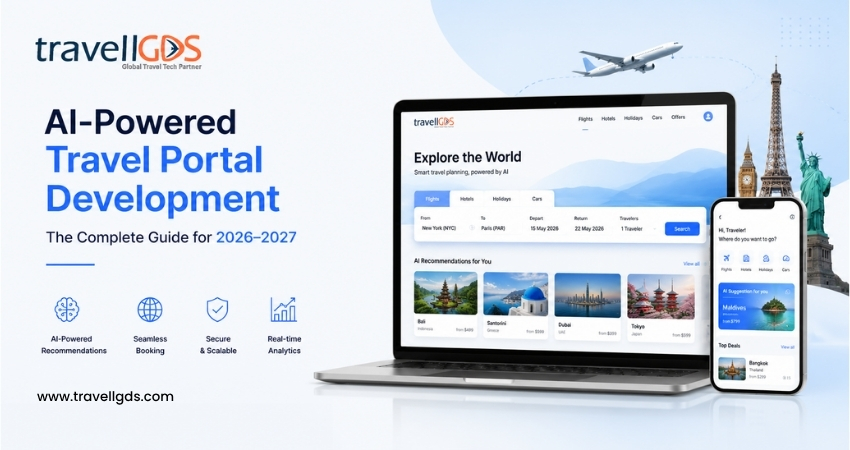
This comprehensive guide explores everything you need to know about AI-powered travel portal development in 2026–2027. It covers essential features, API integrations, AI capabilities, and the business value of intelligent booking automation. Whether you are a travel startup, an established OTA, or a B2B travel supplier, understanding how to build or modernize a travel booking platform has become essential. It is the foundation of future-ready travel commerce.
The travel industry is experiencing one of its biggest technological transformations. Traditional booking methods once dependent on phone calls, manual reservations, and static fare databases have evolved into intelligent, AI-driven travel portals that respond to traveler needs in real time. With artificial intelligence, cloud computing, and API aggregation working together, both traveler expectations and business requirements have changed significantly.
Today, successful travel companies are doing far more than building websites. They are creating intelligent booking ecosystems capable of searching thousands of suppliers simultaneously, personalizing search results, automating pricing decisions, and processing multi-currency payments without friction. This is the new benchmark for travel portal development and a key factor separating market leaders from their competitors.
In this guide, you’ll discover every major component of a modern AI-powered travel booking system. From technical architecture and API integrations to payment gateways, user experience, and AI-powered personalization, you’ll gain the insights needed to make informed technology decisions for your travel business.
What Is a Travel Portal and Why AI Integration Is Now Essential
A travel portal is a web-based or mobile platform that enables travelers and travel agents to search, compare, and book services such as flights, hotels, car rentals, tours, and visa assistance. It connects users with real-time travel inventory through travel XML API suppliers and global distribution systems.
What makes an AI-integrated booking engine different from a traditional platform is its ability to learn and adapt. Instead of displaying static search results, AI analyzes user behavior, identifies seasonal trends, personalizes recommendations, automates upselling opportunities, highlights price-drop alerts, and optimizes inventory allocation in real time.
The business advantages are substantial. Travel portals powered by predictive analytics and AI personalization often achieve higher conversion rates, lower cart abandonment, and stronger customer retention. As competition continues to increase, AI integration has become one of the most important differentiators for modern travel businesses.
A travel portal without AI-driven personalization is like a storefront without clear signage. Even with excellent inventory, it cannot effectively guide travelers to the right products at the right time.
The Core Architecture of a Modern Travel Booking Platform
Before starting any travel booking platform development project, it is important to understand the technology behind it. Modern travel portals are no longer built as single, monolithic applications. Instead, they consist of multiple interconnected layers, each designed to perform a specific function efficiently while ensuring scalability and performance.
Frontend Booking Interface
The front-end is the customer-facing layer of the platform. It includes the search engine, filtering options, booking forms, search results, and checkout process. A high-performing travel portal UI should display results quickly, provide a mobile-first experience, and make comparing travel options simple and intuitive. Progressive Web App (PWA) technology has become increasingly popular because it delivers an app-like experience directly through the browser without requiring users to download a mobile application.
API Integration Layer
Behind the user interface is the API integration layer, which connects the portal with external travel suppliers. This includes integration with GDS platforms such as Amadeus, Sabre, and Travelport for flight inventory, along with hotel providers like Hotelbeds and Expedia Partner Solutions. Through Travel XML API integration, the system retrieves real-time data from multiple suppliers and presents users with a single, unified set of search results.
Booking and Reservation Engine
The reservation management engine manages the complete booking process. It performs availability checks, validates fare rules, creates PNRs, issues tickets, and supports booking modifications after purchase. This layer must deliver fast performance while maintaining reliability, even during peak booking periods or temporary supplier API disruptions.
AI and Analytics Engine
The AI engine collects and analyzes traveler behavior to understand user intent and automate decision-making. It powers advanced features such as dynamic pricing, personalized recommendations, demand forecasting, intelligent search rankings, and automated upselling opportunities. When integrated effectively, this layer enhances every stage of the booking journey and improves overall platform performance.
Key Features Every AI-Powered Travel Portal Must Include
- Real-Time Flight Search: Connect directly with GDS platforms to provide live flight availability, fare classes, and multi-city itinerary searches across global airlines.
- Hotel Booking Module: Integrate with hotel API providers to display real-time room availability, competitive pricing, and automated booking confirmations.
- AI Price Prediction: Use machine learning to analyze historical fare trends, predict future price changes, and notify travelers about the best time to book.
- Multi-Currency Payment: Support global payment gateways such as Stripe, PayPal, Razorpay, and regional providers with real-time currency conversion for seamless international transactions.
- Agent Back-Office Portal: Provide a dedicated dashboard where B2B travel agents can manage bookings, configure markups, generate reports, and process cancellations efficiently.
- Automated Itinerary Builder: Enable AI-powered itinerary automation to create personalized travel packages by combining flights, hotels, transfers, and additional travel services.
- NDC Content Access: Support IATA’s New Distribution Capability (NDC) standard to deliver richer airline content, personalized offers, and ancillary services directly from airlines.
- Mobile-First Design: Build a responsive or Progressive Web App (PWA) that provides a fast, intuitive booking experience across smartphones, tablets, and desktops.
- Travel CRM Integration: Connect with CRM platforms such as Zoho CRM or Travefy to manage customer information, automate follow-ups, and strengthen loyalty programmes.
- AI Chatbot Support: Offer intelligent virtual assistants that handle booking inquiries, cancellations, travel recommendations, and customer support around the clock.
Beyond these essential capabilities, leading travel platforms are also adopting voice search, biometric authentication, and advanced security features. Together, these technologies create a smarter booking experience while increasing customer satisfaction and driving higher revenue.
The Role of GDS, NDC, and API Aggregation in Travel Distribution
A Global Distribution System (GDS) has long been the backbone of travel distribution, allowing travel agencies to access airline, hotel, and car rental inventory through a centralized platform. Major providers such as Amadeus, Sabre, and Travelport aggregate travel content from thousands of suppliers and deliver it through standardized interfaces. For any flight booking system, GDS integration remains a critical foundation.
However, the travel distribution landscape continues to evolve. New Distribution Capability (NDC), an XML standard developed by IATA, enables airlines to distribute their products directly to travel sellers without relying solely on traditional GDS platforms. This gives airlines greater control over personalized offers, bundled services, seat selection, and ancillary products that are often unavailable through conventional distribution channels. As a result, many modern travel portals now combine GDS connectivity with NDC integration to deliver broader inventory and richer content.
Beyond airline bookings, API aggregation extends the same approach to hotels, car rentals, sightseeing tours, transfers, and other travel services. Rather than integrating with every supplier individually, a robust hotel API integration layer consolidates multiple supplier feeds into a unified platform. This simplifies development, improves response times, and allows travelers to compare a much wider range of travel options from a single search.
For travel businesses, the impact is significant. The quality and breadth of your supplier integrations directly influence your platform’s competitiveness. A travel portal with limited API connectivity will struggle to match the inventory, pricing, and flexibility offered by competitors with broader distribution networks.
How AI Is Transforming Travel Personalization and Booking Automation
Artificial intelligence has become an essential part of modern travel technology. It is no longer an emerging trend it is actively transforming how travelers search, compare, and book their journeys. Today, the most valuable applications of AI in travel focus on personalization, automation, and demand forecasting.
Personalized Search Ranking
Traditional booking platforms typically display results based on fixed criteria such as price or departure time. In contrast, AI-driven travel platforms personalize search results using booking history, browsing behavior, traveler preferences, device type, and real-time engagement signals. For example, a frequent business traveler will receive different recommendations than a family planning a vacation. This personalized experience shortens the booking journey and improves conversion rates.
Dynamic Pricing and Revenue Optimization
For travel companies managing their own inventory including hotels, tour operators, and consolidators AI-powered dynamic pricing delivers a major competitive advantage. By analyzing demand trends, competitor pricing, booking patterns, and seasonal fluctuations, AI automatically adjusts pricing to maximize revenue. Once available only to major OTAs such as Booking.com and Expedia, this technology is now accessible to businesses of all sizes through modern travel SaaS platforms.
Automated Customer Support
AI-powered chatbots and virtual assistants now manage a large percentage of customer interactions. They help travelers check booking status, process cancellations, answer destination-related questions, and provide documentation guidance. When connected with a travel CRM such as Zoho CRM or Travefy, these intelligent assistants deliver personalized, context-aware responses that improve customer satisfaction while reducing operational costs.
Fraud Detection and Payment Security
Travel transactions often involve high-value international payments, making fraud prevention a top priority. AI-powered fraud detection systems integrated with payment providers such as Stripe and Razorpay analyze hundreds of transaction signals in real time to identify suspicious activity before payments are processed. This level of protection is essential for any travel portal development project serving customers worldwide.
White Label Travel Solutions: The Fastest Path to Market
For travel businesses looking to launch quickly without building an entire booking platform from scratch, white label travel solutions offer the fastest and most cost-effective route to market. A white label platform is a ready-to-use booking engine that can be customized with your branding while already including supplier APIs, payment gateways, and back-office management tools.
The benefits are significant. Development timelines are reduced from several months to just a few weeks. Many supplier API agreements are already in place, and essential features such as the flight booking system, hotel booking engine, and payment processing are fully tested before deployment. This allows your team to focus on business growth, customer acquisition, and marketing rather than software development.
However, choosing the right white label solution is critical. Key evaluation factors include supplier coverage, customization capabilities, API update frequency, uptime guarantees, mobile performance, and support for multiple languages and currencies. A platform that lacks flexibility or limits your branding and pricing strategy can restrict long-term business growth.
TravellGDS specializes in delivering travel portal development and white label travel solutions that combine rapid deployment with enterprise-level flexibility. Whether you need a B2C booking engine, a B2B travel portal, or a tour operator extranet, every solution is designed to scale alongside your business.
Travel Payment Integration: Building a Frictionless Checkout Experience
Payment friction remains one of the biggest reasons travelers abandon their bookings. After spending time selecting flights, hotels, and travel services, users are unlikely to complete their purchase if the checkout process is slow, complicated, or offers limited payment options. That is why travel payment integration is more than a back-end feature it is a key driver of revenue and customer satisfaction.
A modern travel booking portal should support multiple payment methods, including credit and debit cards, digital wallets, bank transfers, and Buy Now, Pay Later (BNPL) options. International travel businesses should integrate global payment providers such as Stripe and PayPal while also supporting regional gateways like Razorpay for India, Airwallex for cross-border B2B transactions, and Wise for multi-currency supplier payments.
Equally important is the checkout experience itself. A streamlined payment flow should minimize the number of steps required to complete a booking, support one-click payments for returning customers, display transparent real-time currency conversion, and provide instant booking confirmation with automated e-ticket generation. These improvements help reduce booking abandonment and build customer trust.
For enterprise travel businesses, fintech integration extends beyond payment collection. Features such as automated reconciliation, supplier payment scheduling, and real-time financial reporting simplify operations while giving finance teams greater visibility into cash flow and booking performance.
The Future of Mobile-First Travel Booking Platforms
Mobile devices now generate the majority of travel searches worldwide, and an increasing number of bookings are completed directly from smartphones. This makes one fact clear: mobile is no longer a secondary channel. It is the primary booking platform, and travel businesses that fail to prioritize mobile experiences risk losing valuable customers and revenue.
The next generation of mobile travel platforms goes beyond responsive websites. Progressive Web Apps (PWAs) deliver near-native app experiences through a web browser, offering features such as offline access, push notifications, and home-screen installation without requiring downloads from an app store. This approach improves accessibility while reducing development and maintenance costs.
Voice search is another rapidly growing capability in mobile travel technology. Travelers increasingly use natural voice commands like “Find me a direct flight to Dubai next Friday.” Powered by Natural Language Processing (NLP), AI-enabled travel portals can understand conversational queries and deliver highly relevant search results, making the booking experience faster and more intuitive.
Looking ahead, technologies such as augmented reality (AR) are becoming more practical for travel businesses. Virtual hotel room tours, interactive destination previews, and immersive seat maps are evolving from innovative concepts into valuable customer engagement tools. Travel companies that begin adopting these experiences today will be well-positioned for the next wave of digital transformation.
Choosing the Right Travel Technology Partner for Your Portal Development
Selecting the right travel technology partner is one of the most important decisions in any travel portal project. The expertise of your development partner influences not only your platform’s features but also its scalability, reliability, and long-term success. When evaluating potential vendors, consider far more than technical development skills.
- Domain Expertise: Choose a partner with proven experience in GDS integration, travel XML APIs, booking engine development, and payment gateway integration. Industry-specific expertise reduces implementation risks and accelerates deployment.
- Supplier Relationships: Established partnerships with providers such as Hotelbeds, Amadeus, Sabre, Travelport, and Viator help reduce onboarding time while providing access to stronger commercial agreements.
- Scalable Architecture: Ensure your platform is built using cloud-native infrastructure with load balancing, CDN support, and scalable architecture capable of handling seasonal traffic spikes without affecting performance.
- Post-Launch Support: A travel portal requires continuous maintenance, supplier API updates, security patches, and performance optimization. Look for a partner that offers dependable SLA-backed support long after deployment.
- Customization Flexibility: Every travel business operates differently. Your technology partner should be able to customize booking workflows, pricing rules, commission structures, and user experiences to match your business model.
TravellGDS has been delivering travel portal development solutions since 2013, serving B2C travel portals, B2B booking platforms, hotel extranet systems, and tour extranet systems. Built on reliable LAMP architecture with seamless API connectivity to leading travel suppliers, every solution is designed for high performance, scalability, and sustainable business growth.
Measuring Success: KPIs for Your Travel Portal in 2026
Launching a travel booking portal is only the beginning. To maximize your return on investment, you need to monitor the right performance indicators and continuously optimize your platform. Measuring the right KPIs helps identify growth opportunities, improve user experience, and increase long-term profitability.
Booking Funnel Metrics
- Search-to-Booking Conversion Rate: This measures the percentage of users who complete a booking after performing a search. AI-powered personalization and relevant search results play a major role in improving this metric.
- Cart Abandonment Rate: This tracks the percentage of travelers who begin the checkout process but leave before completing their booking. High abandonment rates often indicate payment friction, complicated checkout flows, or a lack of trust signals.
- Average Booking Value: Monitor the average revenue generated from each completed booking, including additional services such as travel insurance, seat upgrades, baggage, transfers, and other ancillary products.
Technical Performance Metrics
- API Response Time: Measure how quickly supplier APIs return search results. Competitive real-time booking platforms should deliver search responses in under two seconds whenever possible.
- Uptime and Availability: Your travel portal should maintain at least 99.9% uptime to ensure uninterrupted booking experiences, particularly during peak travel seasons when every minute of downtime impacts revenue.
- Mobile Load Speed: Mobile performance directly affects both search rankings and booking conversions. A well-optimized travel portal should load its core pages in under three seconds on a standard mobile network.
Commercial Performance Metrics
- Revenue Per Visitor (RPV): This combines conversion rate and average booking value into a single metric, providing a clear picture of your platform’s overall revenue efficiency.
- Customer Acquisition Cost (CAC) vs. Lifetime Value (LTV): Comparing acquisition costs with long-term customer value helps determine whether your marketing investments are generating sustainable business growth.
- Supplier Margin Performance: For B2B travel portals, monitoring profitability by supplier helps optimize inventory selection, improve pricing strategies, and strengthen supplier negotiations over time.
Conclusion: The Future of Travel Technology Belongs to Those Who Build for It
The move toward AI-powered travel portal development is more than a technology trend it represents a fundamental shift in how travel is discovered, booked, and experienced. The platforms leading the future of online travel are being built today with intelligent automation, seamless API connectivity, mobile-first experiences, and payment systems designed to remove every barrier between search and booking.
Whether you are a startup launching your first travel booking platform or an established travel agency upgrading a legacy system, the strategy remains the same: invest in technology that can evolve, scale, and continuously improve. Businesses that rely on outdated systems will increasingly struggle to compete with companies embracing AI-driven innovation.
The opportunities for travel businesses continue to expand as global travel demand grows and customer expectations become more sophisticated. Organizations that combine strong supplier partnerships with intelligent technology will shape the next generation of travel commerce. Choosing the right travel technology partner is the first step toward building a platform designed for the future rather than the past.
Contact TravellGDS today to discuss your travel portal development project and discover how our experts can help you build a scalable, AI-powered travel booking platform.
Frequently Asked Questions
What is AI-powered travel portal development?
AI-powered travel portal development is the process of building an online travel booking platform that uses artificial intelligence to improve the customer experience and business performance. AI capabilities include personalized search results, dynamic pricing, demand forecasting, automated customer support, and intelligent booking recommendations. Unlike traditional booking systems, AI-powered portals continuously learn from user behavior and adapt in real time to deliver more relevant travel experiences.
How long does it take to build a travel portal from scratch?
The development timeline depends on the project’s complexity, required features, and supplier integrations. A basic travel portal with flight and hotel booking functionality and one or two API integrations can typically be completed within 8–12 weeks. A more advanced platform featuring multiple supplier integrations, B2B functionality, AI-powered personalization, and custom payment workflows generally requires 16–24 weeks. Businesses choosing white label travel solutions can often launch within 4–8 weeks.
What is the difference between a GDS and an NDC travel portal?
A Global Distribution System (GDS) such as Amadeus, Sabre, or Travelport provides centralized access to airline, hotel, and travel inventory through standardized distribution channels. In contrast, New Distribution Capability (NDC) is an IATA XML standard that enables airlines to distribute personalized offers, ancillary services, and bundled products directly to travel sellers. Modern travel portals often integrate both technologies to maximize inventory availability and provide richer booking experiences.
What travel APIs should I integrate into my booking platform?
The ideal API combination depends on your business model. Flight booking platforms typically integrate with GDS providers such as Amadeus, Sabre, and Travelport. Hotel booking systems commonly use Hotelbeds and Expedia Partner Solutions. Tours and activities are frequently powered by Viator APIs, while payment processing relies on providers such as Stripe and Razorpay. Working with a travel XML API supplier offering multiple pre-built integrations can significantly reduce development time and simplify supplier onboarding.
What is a white label travel solution and who should use it?
A white label travel solution is a ready-made travel booking platform that can be customized with your brand identity without developing the core technology from scratch. It is an ideal solution for travel agencies, tour operators, B2B travel businesses, and startups that want to launch quickly with integrated supplier APIs, payment gateways, and booking management features while minimizing development costs and time-to-market.
How does dynamic pricing work in a travel booking engine?
Dynamic pricing uses artificial intelligence and machine learning to adjust travel prices in real time based on demand, booking trends, competitor pricing, seasonality, and customer behavior. For businesses managing their own inventory such as hotels, tour operators, or travel consolidators this technology helps maximize revenue by automatically increasing prices during periods of high demand and lowering them when demand decreases. It applies the same revenue optimization strategies used by leading OTAs and airlines to improve profitability.
Is mobile booking support essential for a travel portal in 2026?
Yes. Mobile devices now account for the majority of travel searches and an increasing percentage of online bookings worldwide. A travel portal that is not optimized for mobile devices will likely experience higher bounce rates and lower conversion rates. To deliver the best user experience, your platform should feature fast loading times, intuitive navigation, secure mobile payments, and a streamlined checkout process. Progressive Web App (PWA) technology is widely recommended because it offers app-like performance without requiring users to install a native application.
What payment gateways work best for online travel portals?
The best payment gateway depends on your target market and business requirements. Stripe is widely recognized for secure global card payments, advanced fraud protection, and developer-friendly APIs. PayPal enhances customer trust and supports digital wallet transactions. Razorpay is an excellent choice for businesses serving the Indian market, offering support for UPI, net banking, credit cards, and EMI payments. For international B2B travel businesses, Airwallex and Wise simplify multi-currency payments and supplier settlements. Most successful travel portals integrate multiple payment providers to maximize payment success rates and provide customers with greater flexibility.
How do I choose the right travel technology company for my portal?
Selecting the right travel technology company requires evaluating both technical expertise and industry experience. Choose a partner with proven knowledge of GDS integrations, travel API connectivity, booking engine development, and scalable cloud architecture. Review their portfolio of live travel platforms, assess the quality of their mobile experience, and confirm that they provide reliable post-launch support, security updates, and ongoing maintenance. TravellGDS offers comprehensive travel portal development services backed by more than a decade of experience in the travel technology industry.
What is a hotel extranet system and does my travel portal need one?
A hotel extranet system is a web-based management portal that allows hotel partners to update their own inventory, room availability, pricing, images, and property details directly within your travel platform. If your business works directly with hotels instead of relying exclusively on third-party APIs, an extranet system is essential. It reduces manual administration, improves data accuracy, and enables suppliers to manage their properties in real time. This functionality is especially valuable for B2B travel portals, wholesalers, destination management companies, and travel marketplaces. TravellGDS provides a fully featured hotel extranet system as part of its complete travel technology solutions.